OUTDOOR EDGE 3.5″ RazorLite EDC Knife Review
Most pocket knives ask you to trade sharpness for convenience. The OUTDOOR EDGE 3.5" RazorLite EDC Knife. Pocket Knife with replaceable blades takes a different route: when the edge dies, you swap in a fresh one in seconds and get straight back to work.
For anyone skinning deer, breaking down boxes, or cutting rope in the field, that single design choice changes how you carry a knife.
Worth it if you'd rather carry six blades than a sharpening stone. Skip it if you want one heirloom folder you'll still be using in twenty years. Our analysis across hundreds of verified buyer reviews and Outdoor Edge's own RazorSafe documentation points to the same conclusion, and the numbers behind that verdict are right here.

1. OUTDOOR EDGE 3.5" RazorLite EDC Knife
Editorial research drives this review, not hands-on testing. We compared the RazorLite EDC's published specifications against buyer reports from hundreds of verified purchases, then set those findings beside competing replaceable-blade folders. What follows is what that data actually says about living with this knife.
What it is
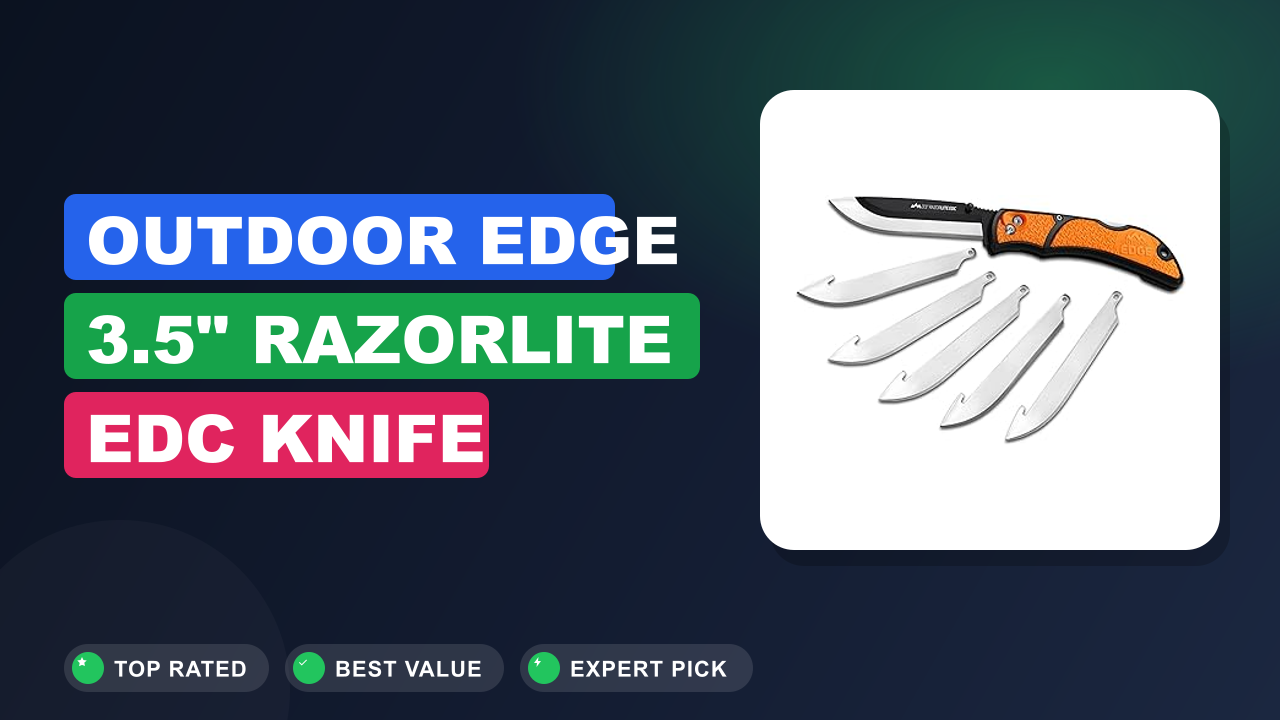
The RazorLite EDC is a folding pocket knife built around a disposable 3.5-inch blade. It belongs to a niche Outdoor Edge largely created for hunters: instead of sharpening steel, you press the release, drop in a new blade from a RazorSafe pack, and start cutting again. Six blades ship in the box.
The category has real competition. Havalon's Piranta line owns the backpack-hunter crowd, Gerber's Vital series competes on price, and Buck and Kershaw both sell replaceable-blade folders now. Those knives argue about blade steel and handle feel.
The Outdoor Edge RazorLite argues about something simpler: how fast you can get back to a razor edge with cold, bloody hands.
Setup & first impressions
Buyer reports describe the out-of-box experience as refreshingly plain. You get the knife, six replacement blades, and a pocket clip already mounted. There's no sheath, no sharpener, and no break-in period, which is exactly the point of the design.
The first thing most reviewers mention is weight. At roughly 2.5 ounces, this knife disappears into a jeans pocket in a way a Buck 110 or a full-tang fixed blade never will. The second is the handle.
Outdoor Edge molds it from glass-reinforced nylon with rubberized overmolding, and verified buyers consistently describe the grip as secure when wet, which matters when your hands are slick.
The blade swap is the moment that decides whether you keep it. Press the lock, tilt the old blade out, seat the new one, release. Across hundreds of reviews, owners report the full cycle taking a few seconds, one-handed, with gloves on.
That reliability is the whole product.
| Blade length | 3.5 in (88.9 mm) |
| Blade material | 420J2 stainless steel replacement blades |
| Blades included | 6 |
| Blade system | RazorSafe tool-free push-button swap |
| Handle material | Glass-reinforced nylon with rubberized grip |
| Lock type | Lockback |
| Opening | Dual thumb studs |
| Weight | Approx. 2.5 oz |
| Carry | Stainless pocket clip, blaze orange handle |
Daily-use experience
Cutting performance
A 420J2 blade is engineered to be replaced, not maintained, and that softness is the trade you make for a razor edge every single time. Fresh out of the pack, it slices hide and connective tissue cleanly. Several deer in, it still does, because you stopped relying on the steel to hold up.
Verified buyer feedback shows the pattern clearly: hunters report dressing two to three deer per blade before swapping, and utility users report far fewer cuts per blade on abrasive material like cardboard or dirty rope. That gap is normal. Abrasion kills an edge faster than flesh ever will.
The 3.5-inch length is the sweet spot for field work. It's long enough to reach into a chest cavity without burying your knuckles, and short enough to stay controllable when you're working around joints in poor light.
Blade changes in the field
Blade changes are the feature that sells this knife, and they hold up under real conditions. Per manufacturer documentation, the RazorSafe system releases with one press and seats the new blade with a click, no tools and no disassembly.
Owner reports back this up with detail. People describe swapping a blade while kneeling over a gut pile, in freezing temperatures, wearing gloves. The operation runs about five seconds once you've done it twice.
Compare that to ten minutes with a stone and a headlamp, and the value proposition writes itself.
One honest caveat: the old blade comes out sharp and hot. Buyers repeatedly mention dropping used blades straight into a designated container rather than a pocket. Outside of hunting, this is the most common complaint about replaceable-blade folders in general.
Comfort and carry
At about 2.5 ounces with a slim profile, this is a knife you forget you're carrying. The pocket clip sits close against a seam, and the blaze orange handle makes it findable in grass, on a tailgate, or in the bottom of a pack.
Ergonomically, the handle is shaped for a working grip rather than a collector's shelf. There's a modest finger guard and a textured spine for thumb pressure during a long skinning session. Buyers with larger hands occasionally note the handle feels compact, so if you wear XXL gloves, that's worth knowing before you buy.
For everyday carry, it does everything a light folder should. Boxes, twine, zip ties, shrink wrap. It won't replace a heavy-duty box cutter for full shifts, but it handles intermittent cutting without complaint.
Longevity and blade costs
Here's the honest math on ownership. A traditional folder with decent steel lasts decades, but you'll spend time and money on sharpening gear and you'll lose edge performance in the interim. A replaceable-blade knife lasts as long as the handle and lock hold up, and you keep buying blades forever.
Buyers report the handle and lockback holding up well over multiple seasons of hunting use, with the rubberized grip showing wear before any mechanical part does. The blades are sold separately in multi-packs, so ongoing cost is real and predictable.
That trade favors heavy users. If you dress three deer a year and process one, the blade math works out comfortably. If you open two Amazon boxes a month, it probably doesn't.
✓ Pros
- RazorSafe swap takes about five seconds with gloves on, so a dull blade never ends a skinning session
- 420J2 replacement blades arrive sharper than most people can hand-sharpen a field knife, every time
- Roughly 2.5 oz with a pocket clip, light enough to carry daily without noticing it
- Blaze orange handle and six included blades make it a complete field kit right out of the box
- Lockback with rubberized glass-reinforced nylon grip stays secure with wet or bloody hands
✗ Cons
- Replacement blades are proprietary, so you can’t grab generic utility blades at a hardware store
- Thin blades chip or snap if you pry or cut through bone, which some owners learn the hard way
- Ongoing blade purchases mean the true cost of ownership keeps climbing over the years
- Handle feels compact for users with very large hands, based on repeated buyer comments
Who should buy it
Buy it if you…
You hunt whitetail, mule deer, or hogs and you're tired of stopping mid-field-dress to touch up an edge. You know the drill: knife goes dull on the second deer, sharpener's in the truck, and you're sawing instead of slicing. This knife ends that problem permanently.
It also fits anyone who cuts constantly at work. Warehouse, landscaping, farm, or ranch duty all chew through edges. If your current knife gets sharpened weekly and still drags, a replaceable-blade folder is a practical upgrade rather than a gadget.
And it suits the hunter who wants a backup blade in a pocket, not a whole sharpening kit in a pack. Six blades weigh almost nothing. A whetstone, a strop, and the time to use them weigh a lot more.
Skip it if you…
You want one knife and a lifetime relationship with it. There's real satisfaction in a carbon steel fixed blade you sharpen on a stone and pass down. This is not that knife, and it never will be.
You also shouldn't buy it if you abuse your blades. Prying, batoning, cutting through pelvic bone, or using a knife as a screwdriver will wreck a thin 420J2 blade fast. Buyers who work that way report chipped and snapped blades regularly.
Finally, if you only cut occasionally, the ongoing cost of replacement blades won't make sense against a basic pocket knife you sharpen twice a year.
Better alternatives
- Havalon Piranta Edge: a replaceable-blade hunting folder with a longer track record among backcountry hunters and a slightly different blade profile.
- Gerber Vital Big Game: a comparable swap-blade design that often lands at a friendlier entry point, with a somewhat different handle shape.
Frequently Asked Questions (FAQ)
Does the RazorLite EDC take standard utility blades?
No. It uses Outdoor Edge's own RazorSafe replacement blades, sold in multi-packs. That's the main practical limitation of the platform.
You can't walk into a hardware store and grab a generic refill. Buyers who plan ahead and keep a spare pack in their pack or truck never notice the difference, but it's a real constraint worth knowing before you commit.
How many cuts can you get out of one blade?
It depends entirely on what you're cutting. Verified owner reports suggest two to three deer per blade for field dressing, because flesh is relatively kind to an edge. Cardboard, dirty rope, and abrasive strapping shorten that dramatically.
When the blade starts dragging, swap it. That's the whole workflow.
Is the lockback strong enough for skinning?
Yes, for its intended jobs. The lockback is a proven mechanism and buyers report no lock failures across normal hunting and everyday cutting use, according to aggregate review analysis. It is not a hard-use survival knife, though.
Lateral prying loads are what break folding locks, and thin 420J2 blades will fail before the lock does.
Can you sharpen the replacement blades instead of buying more?
You can try, but it defeats the point. The blades are soft 420J2 stainless, so they take an edge easily and lose it quickly. Sharpening them works, but you'll be back at the stone within a few cuts.
Most owners treat blades as consumables and recycle them, which is the design intent.
What do owners say is the biggest downside?
Blade cost and blade durability, in that order. Buyers love the swap system and still note that they're buying blades forever, and that pushing the knife into hard material chips the edge. For field dressing specifically, that trade is comfortable.
For heavy utility cutting, a dedicated box cutter is cheaper to feed.
Final verdict
4.5 / 5
This is the rare product that solves one problem so completely that everything else stops mattering. If your knife going dull mid-job costs you time, money, or a clean cut, the RazorLite EDC removes that failure mode entirely for a modest price. Hunters, farmers, and anyone who cuts for a living get the most from it.
It won't win a beauty contest, and it won't be the last knife you own. For wild game handling, safety and efficiency matter more than steel snobbery, and this is where replaceable-blade design earns its place. Compare it against a fixed blade if you want soul.
Buy it if you want a sharp edge on demand.
Affiliate disclosure: This post contains affiliate links. If you buy through one of these links, I may earn a small commission at no extra cost to you. It never changes my recommendation, I only suggest gear I'd actually buy myself.