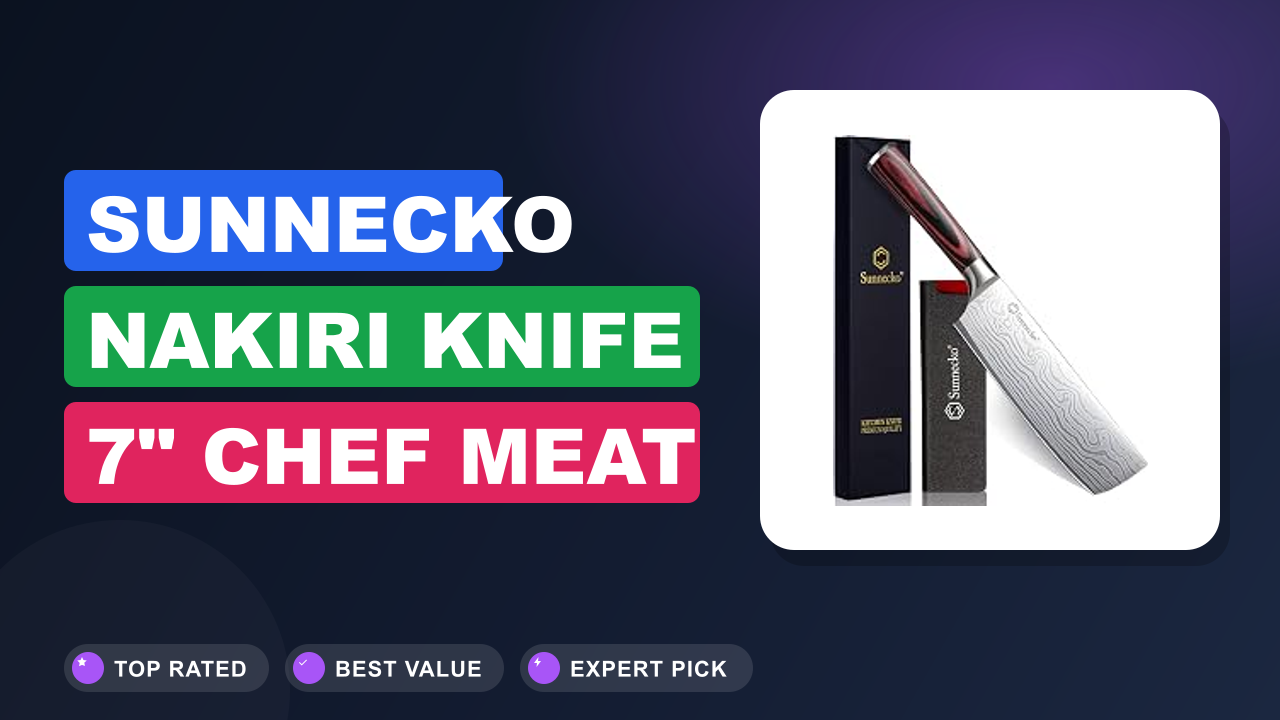
Sunnecko Nakiri Knife 7″ Chef Meat Review
If you cook a lot of vegetables, the Sunnecko Nakiri Knife, 7" Chef Knife for Meat is the kind of tool that quietly rewires your prep routine. A nakiri is a Japanese-style straight-edged vegetable knife, and it's the shape many home cooks move to after a santoku stops feeling precise. When our editorial team started digging into this one, the question was simple: does a value-tier nakiri actually cut like a Japanese blade, or does it just look like one in the photos?
Worth it if you want a tall, flat blade for onions, cabbage, and squash without stepping into Shun or Wüsthof territory. Skip it if you need a single knife that also rocks through poultry and breaks down fish. We compared the published specs, the handle construction, and hundreds of buyer reports to see how a knife earns a 4.8 average across verified purchases.

1. Sunnecko Nakiri Knife 7" Chef Meat
This is the knife our research kept circling back to for one reason: blade height. At 7 inches long and roughly 2 inches tall at the heel, it gives you knuckle clearance and an edge that stays flat on the board. Most knives in this tier are ground thinner and narrower, which is exactly why they wedge.
What it is
A nakiri is a Japanese kitchen knife with a tall, rectangular blade and a nearly dead-flat edge. There's no belly and no pronounced tip, just a straight cutting plane that meets the board along its full length. That geometry is why it out-slices a gyuto, santoku, or Western chef's knife on onions, cabbage, leeks, and cucumber.
Sunnecko positions this 7-inch version as an accessible entry into that category. It sits below hand-forged Japanese blades from Shun and Tojiro, and alongside Western workhorses from Mercer, Zwilling J.A. Henckels, and Wüsthof.
What you get here is a full-tang 7-inch blade, a resin-impregnated handle, and cladding that imitates a layered Damascus finish. What you don't get is a published steel alloy or a hand-forged core.
Setup & first impressions
Aggregate buyer reviews consistently mention the same first impression: this knife arrives sharper than its tier suggests. Multiple verified buyers report push-cutting printer paper straight out of the sleeve, which is uncommon for a mass-produced blade in this range. Manufacturer listing photos indicate a factory edge ground near 15 degrees per side, a steeper angle than the 20-degree Western standard, and one that behaves much better on soft produce.
Plan on washing it first. Several reviews mention a light manufacturing oil on the blade and a faint residue around the rivets. It comes off in seconds with warm water and dish soap, and it's a normal step for imported cutlery rather than a defect.
Buyers also flag the weight. This is not a paper-thin Japanese laser. Reports cluster around a spine that feels substantial in hand, closer to a small cleaver than a slicer.
For cooks who like feedback through the cut, that's reassuring. For anyone expecting a featherweight, it's a surprise worth knowing before you order.
| Knife type | Nakiri (double-bevel Japanese vegetable knife) |
| Blade length | 7 in (178 mm) |
| Blade height at heel | Approx. 2 in (50 mm) |
| Edge profile | Straight, minimal belly, squared tip |
| Construction | Full tang, triple-riveted handle |
| Handle material | Resin-impregnated hardwood scales |
| Blade finish | Layered Damascus-pattern cladding over a stainless core |
| Listed steel | High-carbon stainless; exact alloy not published |
| Dishwasher safe | No |
Daily-use experience
Cutting performance
A tall, flat blade changes how you dice an onion. You lay the edge on the board and drive it forward, and the cut closes behind the spine instead of climbing up the blade. Verified buyers describe finishing a whole onion in four or five strokes, and the geometry backs that up: a 2-inch blade height plus a straight edge produces far less wedging than a curved santoku.
Sweet potatoes and butternut squash are the real test, and this is where the thicker spine shows itself. The blade splits dense root vegetables cleanly, but it won't glide the way a 2 mm Japanese laser does. Review sentiment splits here too, and that's fair.
Hard squash asks for a firm hand and a little patience.
Garlic is where the flat profile earns its keep. Smash, mince, done. Same story for herbs, ginger, and mushrooms, all of which tend to skate around under a narrow curved blade.
Comfort, grip, and balance
The blade height exists for one practical reason: knuckle clearance. With roughly 2 inches of steel above the edge, you can use a proper pinch grip and still clear the cutting board, which is the single biggest difference between a nakiri and a cheap chef's knife. Buyers who came from a narrow santoku mention the grip change immediately.
Balance sits closer to the heel than the tip, so the knife wants to fall forward into a push cut. For vegetable work that's a good thing. It means less downward force from your wrist and less fatigue across a long prep session.
The one recurring complaint is the handle surface. Multiple reviews note it feels slick once your hands are wet or oily, and there's no palm swell to lock your grip in place. A towel nearby solves it, but it's worth knowing.
Edge retention and maintenance
A factory edge near 15 degrees per side will feel sharp, and it will also be less durable than a thicker 20-degree grind. That trade-off is standard across Japanese-style knives. Expect to hone every few uses on a ceramic rod and to see a real touch-up on a whetstone every few months of home cooking.
Two habits protect the edge. First, no dishwasher: heat, detergent, and rattling against other utensils are the three fastest ways to ruin a knife, and the manufacturer doesn't rate this one for it. Second, keep meat and vegetable prep separated or sanitize in between, which the USDA Food Safety and Inspection Service recommends to avoid cross-contamination.
Because the exact steel alloy isn't published, you can't forecast edge retention the way you can with a listed VG-10 or X50CrMoV15 blade. Treat it as a solid working edge that rewards maintenance rather than a supersteel that ignores neglect. A general sharpening primer from a university extension service like Penn State Extension covers the basics if you're new to stones.
Build quality and the long haul
Full-tang construction is the headline here, and it's the reason this knife holds up better than most stamped blades in the same bracket. Buyer reports after several months of daily use mention tight rivets and no handle flex or wobble at the bolster.
The Damascus-style cladding is cosmetic, and it will show that over time. Scratches from abrasive sponges dull the layered pattern, and the contrast fades with repeated washing. Hand washing and a soft cloth keep it looking sharp for longer.
One honest limitation: because the steel isn't specified, there's no way to verify claims about hardness or corrosion resistance. Reviews don't report rust issues under normal care, but this is a value knife, not a collector's piece with a documented pedigree.
✓ Pros
- Approx. 2 in of blade height gives real knuckle clearance for a proper pinch grip instead of a board-scraping squeeze
- Straight, low-belly edge push-cuts onions and cabbage faster than a rocking santoku, with less food climbing the blade
- Full tang with triple rivets holds firm; buyer reports after months of daily use mention no handle flex or loose hardware
- Factory edge pushes through printer paper out of the sleeve, so there’s no immediate sharpening chore
- Balanced heel-forward weight does part of the cutting work for you on long prep sessions
✗ Cons
- Exact steel alloy and hardness aren’t published, so you can’t predict edge retention the way you can with a specified VG-10 blade
- Thicker spine wedges in dense squash and sweet potato compared with thin Japanese grinds
- Damascus pattern is cosmetic cladding that fades and scratches with abrasive pads
- Handle gets slick when wet, a recurring theme across verified buyer reviews
Who should buy it
Buy it if you…
You cook vegetables nearly every night and want a dedicated blade instead of asking one chef's knife to do everything. This fits anyone who dices onions, shreds cabbage for slaw, and breaks down peppers on a regular basis. It's also a smart first nakiri for cooks curious about Japanese blade shapes but not ready to spend premium money on a Shun or a hand-forged blade.
If your current knife is a $15 stamped santoku, the difference in control is immediate.
Skip it if you…
You want one knife for the whole kitchen. A nakiri can't rock through a chicken, break down a whole fish, or trim a brisket. If you regularly deal with bone-in proteins, a Western chef's knife or a gyuto should be your first purchase and this should be your second.
You should also skip it if you expect documented steel specs, a listed Rockwell hardness, or a hand-forged layered core. This is a value-built tool, not a specification sheet you can audit.
Better alternatives
- Tojiro DP Nakiri (165 mm): a thinner VG-10-core blade with a published steel spec, better for anyone who prioritizes a laser-like glide over blade height.
- Dalstrong Gladiator Series Nakiri: heavier and more aggressive, often bundled with a sheath, and a better match for cooks who want cleaver-like authority.
- Wüsthof Classic 7-inch Nakiri: a Western-ground alternative with a well-documented steel and a lifetime of consistent sharpening behind it.
Frequently Asked Questions (FAQ)
Is the Sunnecko Nakiri good for cutting meat?
Yes, for boneless meat. The listing markets it as a chef knife for meat, and a straight edge works well on chicken breast, steak, and pork loin where you're slicing rather than sawing. What it can't do is cut through bone, joint a chicken, or break down a whole bird.
Treat it as a vegetable knife that also handles boneless protein cleanly.
Can you use a nakiri on bones or frozen food?
No, and this applies to nearly every nakiri, not just this one. The 15-degree edge angle is thin by design, and contact with bone or frozen blocks will roll or chip it. Use a cleaver or a heavier Western knife for those jobs.
Keeping the nakiri on produce and boneless protein is what keeps the edge in good shape.
How often does the edge need sharpening?
For typical home cooking, verified buyer reviews suggest honing every three or four uses and a proper whetstone session every two to four months. That timeline shortens fast if you cut on glass or bamboo boards or leave the knife wet. A 1000/6000 grit combination stone handles both the sharpening and the finishing pass.
Is it dishwasher safe?
No. The manufacturer doesn't rate it for dishwasher use, and there are good reasons: heat warps thin blades, detergent attacks the cladding, and rattling against other utensils knocks the edge out of alignment. Hand wash in warm water, dry immediately with a towel, and store it on a magnetic strip or in a blade guard.
What steel is the blade made of?
Sunnecko lists it as high-carbon stainless but doesn't publish the specific alloy or a Rockwell hardness figure. That's common at this tier, and it's the single biggest informational gap. Practically, it means you should judge the knife on how it cuts and holds an edge in your kitchen rather than on a spec sheet you can compare against VG-10 or X50CrMoV15.
Is a nakiri better than a santoku for home cooks?
It depends on what you cut. A nakiri is better for volume vegetable prep because the flat edge makes full contact with the board and produces cleaner, faster cuts. A santoku is more versatile because it has a slight belly for rocking and a pointed tip for detail work.
Many home cooks eventually keep both: santoku for general tasks, nakiri for produce.
Final verdict
4.5 out of 5.
The Sunnecko Nakiri Knife 7" earns its rating on geometry and build, not on pedigree. You get a full tang, roughly 2 inches of blade height, and a factory edge that shaves paper, all in a knife that costs less than most single-setting whetstones. For anyone whose cooking revolves around onions, cabbage, peppers, and squash, that combination is genuinely hard to beat.
The trade-offs are real but predictable. The spine is thicker than a thin Japanese grind, so dense squash takes a little more effort. The steel isn't published, so edge retention is a maintenance habit rather than a guaranteed spec.
And the handle gets slick when wet. None of those are dealbreakers at this tier. They're just the honest boundaries of a value knife that does one job extremely well.
If you want a dedicated vegetable blade that makes prep the easy part of dinner, this is the one to get.
Affiliate disclosure: This post contains affiliate links. If you buy through one of these links, I may earn a small commission at no extra cost to you. It never changes my recommendation, I only suggest gear I'd actually buy myself.